It’s “compatible” in that it can represent old JPEG/JFIF data more efficiently and in less space, and the transformation to JPEG XL and back to JPEG/JFIF is lossless (in that you don’t lose any /more/ quality, you can get the same bits back out) and quick enough to be doable on-demand. You could, for example, re-encode all your old photos on your CDN as JPEG XL without loss of quality but save a bunch of disc space and bandwidth when serving to modern browsers, and translate dynamically back to the old format for older browers, all with no loss of quality.


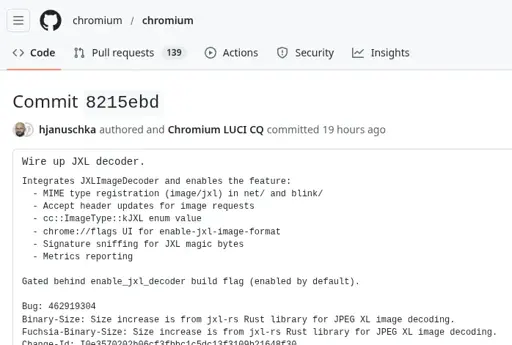
Google tried to sabotage it in favour of its own WebP standard.
Nobody gives a shit about WebP.
deleted by creator
They don’t have to. It’s backwards compatible. You can ignore it and we can keep on happily using it.
Fuck Google, fuck WebP.
deleted by creator
How is JPEG XL backwards compatible?
It’s “compatible” in that it can represent old JPEG/JFIF data more efficiently and in less space, and the transformation to JPEG XL and back to JPEG/JFIF is lossless (in that you don’t lose any /more/ quality, you can get the same bits back out) and quick enough to be doable on-demand. You could, for example, re-encode all your old photos on your CDN as JPEG XL without loss of quality but save a bunch of disc space and bandwidth when serving to modern browsers, and translate dynamically back to the old format for older browers, all with no loss of quality.
So what you’re saying is: both formats can encode image data
deleted by creator