I’ve seen plenty of conservatives say they’d rather have a loud data center than quiet solar farm near their home.
I don’t understand.
And they are cooking the animals!
Bullshit!
headline is clickbait. here’s the only thing it relies on:
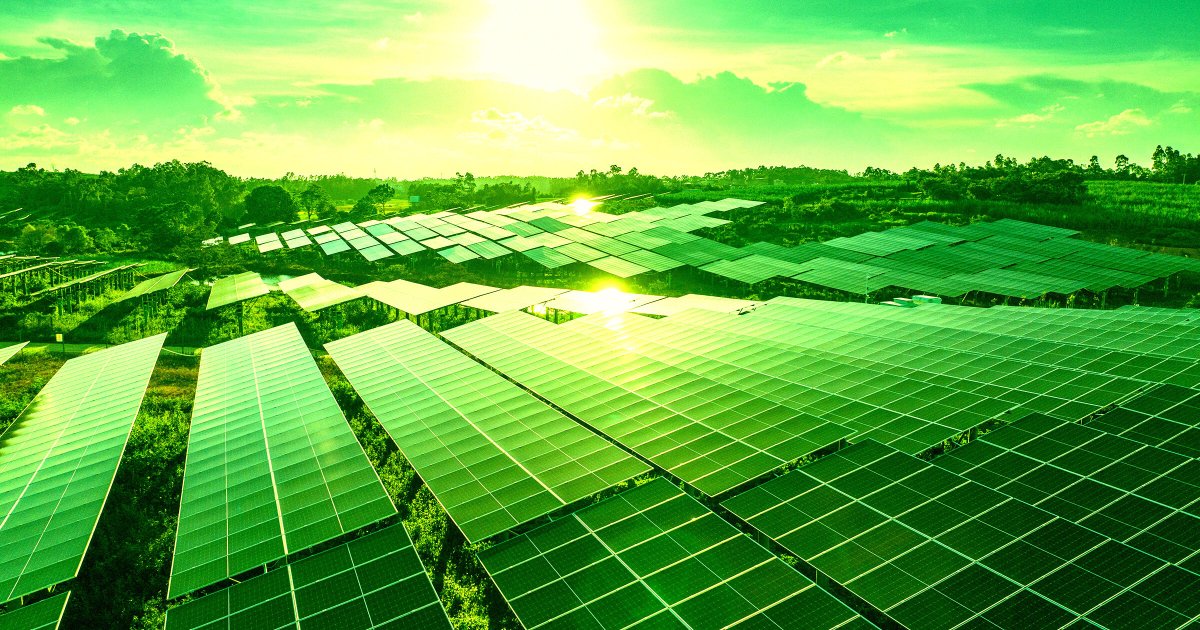
According to new reporting by the BBC, photovoltaics will account for 10 percent of the world’s power generation by the end of 2026, a threshold which will see solar energy officially surpass nuclear fission.
Compared to nuclear energy generation — which has stayed largely flat over the past 26 years globally — the publication notes the volume of solar energy being generated has exploded, increasing some 2,700 times over across the same period.
so it’s saying that nuclear usage share is so low that solar will very soon generate more power than it, not that solar panels are now more efficient than nuclear
nuclear power is expensive to maintain, plus needs all those expertise. and building the power plant takes like a decade+, and then you have to deal regulatory issues.
solar, you can pratically put that anywhere on the cheap.
We could have had this 30 years ago. There have been improvements in the tech and manufacturing, but the main reason for the price drop has been the scale of sales.
We included solar panels and a battery when we built our new house in Tokyo, and even though it’s in a quite shadowy area, I’m surprised how much power we get out of them (even on cloudy days). Switching to an EV now too. It’s an absolute no-brainer.
You mean we can make FREE ENERGY in our BACKYARD for almost NO Money? This is TERRIBLE!
-LITERALLY Conservatives!
Turns out we already have fusion power, it’s just been placed safely 149.6 million km away. The solution to energy independence comes up every morning.
Serious questions for people not looking to play political whack-a-mole and slapping people around online.
I haven’t taken the time to research - but is the “solar overtaking nuclear” because of the dramatic increase in solar farms? Or primarily from the increase of tech? I imagine an mix of both, but the quantity increase seems to be significant.
Are nuclear plants as efficient as they can be? Or are most of plants decades old with problems from aging?
Can the rise of solar be more person to person investment? Or is it’s increase mostly from huge cap ex from people wanting to own and charge for the energy? Nuke is obviously a huge expense begining to end.
While I consider myself pro nuclear, there is something that gets forgotten everytime this conversation comes up.
Nuclear produces waste, which is mentioned often but it is usually responded by pointing out that it could be recycled and the worse to be buried.
Here is what people miss:
Are all our nuclear waste handled correctly today? If not then why should we imply that they will be in the future.
The problem with nuclear isn’t that the waste is impossible to handle, it’s that humans are too short sighted to follow through with it.
And imo that’s a very valid argument on why we should use solar as much as we can.
While I consider myself pro nuclear, there is something that gets forgotten everytime this conversation comes up.
The problem with nuclear isn’t that the waste is impossible to handle, it’s that humans are too short sighted to follow through with it.
Thats not even the biggest problem with nuclear power as the waste angle, at scale, will hit us decades in the future. The more urgent problem hitting us now on even on existing deployed nuclear plants is cooling water.
The byproduct of nuclear power generation is lots AND LOTS of waste heat. You have to get rid of this every second to continue to produce electricity. This is why nuclear power plants are typically built next to a large body of water. However, with reduced water supplies in reseviors theres less water to use for cooling nuclear plants. A double whammy is with climate change increasing temperatures, the water that remains is already hotter than it was, meaning it can carry away even less heat.
If a plant can’t get rid of its heat it needs to curtail (reduce) electricity production. This isn’t just theoretical. Its happening now in 2026 to existing power plants:
-
Hungary - Aug 2026 Hungary plans to shut down only nuclear power plant amid drought
-
Romania - Aug 2026 Nuclear power plants are being shut down as Europe’s drought becomes an energy crisis
-
France & Switzerland - Aug 2026 Droughts cause nuclear power plants in Europe to reduce output
At the time when Europe was experiencing its worst heatwave is recorded history, many European reactors had to be turned down or off. 2026 isn’t the first time this has happened either, you can go back in the last 5 years or so and see many reports of nuclear plant curtailment because of lack of cooling capacity (cool water).
When we know global temperature are rising, it looks like this will just get worse. How can we say nuclear is the future when the conditions for it working well are already declining?
-
Being pro-nuclear was a very valid position up until a few years ago. Now solar has gotten so cheap that there is practically no reason to do it except to protect yourself against US imperialism.
To the disposal argument i like to ask; are we handling our waste from burning fossil fuels well?
Is run away climate change “doing it well”?
Would you rather your waste be buried in the ground or pumped into the atmosphere?
Containing the waste and burying it in the ground is the default for nuclear, meanwhile doing the same for CO2 is very challenging and it may never be viable.
IMHO another big issue with nuclear is concentration of power. nuclear is quite stable, but not always and when it fails you suddenly loose a huge bunch of production that becomes hard to replace. (and Im not even getting into safety here)
France had to deal with a lot of issues just this year, with around 20% of their nuclear plants unoperative, which increased prices dramatically.
Solar is mostly distributed by design (and need) and failures are smaller
A hailstorm wiped out 350mW of solar in Texas in 2024. But, they learned that the angle of panels was critical to avoid damage and now they have a hail storm mode that increases the angle to protect the panels.
Not sure if panels can survive hurricanes, certainly not tornados.
350mW
Maybe they should keep some AA batteries around just in case another hailstorm hits.
fire it into space futurama style
The fact is that humans are just not well equipt to deal with problems beyond human scales.
We’re not good at accurately assessing risks beyond human time scales and we’re not good correctly prioritizing action when the benefit is beyond human time scales.
We also have limited potential stores of uranium. When Chinese reactors all get on line, maybe 40 years left.
Agreed. Are we seriously forecasting 5000 years of stable, deep, under-mountain storage. For all those years, waste storage is a prime target for contaminating locales.
The other quality argument I’ve heard from Lemmy, is that the security requirements for nuclear plants are essential and costly, due to plants being a similar target for creating contamination.
Essentially, nuclear power is a fascist tech, due to the centralised, militaristic, security apparatus required for the life of the plant and waste.
nuclear power is a fascist tech
Calm down, Francis.
Guess which single country is making all the PV panels?
Technically solar power is nuclear power ☝️🤓
All power is solar power if you go deep enough. Or to be more accurate, stellar power.
Big Bang Power
Tidal and geothermal are not.
Pretty sure if the sun stopped generating heat the oceans would freeze but I’m no astrophysicist.
You’re not deep enough yet, tides and earths core only exist because stars exploded billions of years ago and some particles eventually formed earth
That’s what she said
Geothermal comes from friction inside the core, residual heat from planet formation, and radioactive decay. Since all elements heavier than hydrogen were fused inside stars, and heavier actinides like uranium are formed in second gen stars, and the inertia of dust that coalesces into planetary bodies including the earth and the moon originated from dying stars going supernovae, geothermal and tidal energy are products of stellar explosions, either inertial, kinetic, or radioactive. Tides are driven by the moon, whose energy is kinetic, stored from past supernovae
All stars came from the Big Bang.
So it’s all Big Bang powered.
Checkmate.
You’re right, we are all just passengers on this bang bus
This raises an interesting question in my mind, does tidal power make the earth get closer to the moon? Because if you got all the energy out of it, then the water wouldn’t move, so I guess it’s the same as gravitational potential in that sense, but I guess it’s removing it, so less gravitational potential means either less mass (not the case) or less distance.
The opposite happens. Tidal energy is what causes the moon to drift farther away from the earth, as the moon loses angular velocity.
actually, the moon gains angular momentum from the tidal movement that it causes, and that’s what makes it move further away. the reason is that it takes Earth about 1 day to rotate once around its axis, but it takes the moon 28 days to rotate once around Earth’s axis. so Earth has a higher angular velocity, and the tidal movement tries to reduce that difference to make the two tidally locked eventually. ironically, this process transfers angular momentum to the moon (to speed it up), which makes it move further away and thus the angular velocity actually decreases. yeah, orbital mechanics is weird.
(btw this is not a joke. it’s really that way, difficult to comprehend i know).
But does harvesting it make it go faster or slower away?
If you mean harvesting tidal energy, the effect on the moon would be minimal. The loss of angular momentum the moon experiences is due to the mass of the earth’s waters. I could not imagine anything humans could build that could extract enough tidal energy that it would disrupt the moon without utterly destroying the environment at the same time (by way of nullifying tides somehow). In fact, to harness tidal energy, one way would be to use underwater turbines. They would have an immediate effect to the local environment but a negligible amount to the moon itself.
I know its minimal, I’m not saying it’s a concern, I’m just saying if we are harvesting it, doesn’t that mean it’s pulling us closer to it? It’s not magically free energy (in the physics sense), so what else could it be other than converting the potential gravitational energy between the earth and moon into something else?
Planet wouldn’t exist if stars didn’t explode billions of years ago, checkmate.
Most usable energy on Earth comes from fusion of hydrogen into helium in the Sun, creating radiation that hits the Earth. That’s solar energy, of course, either thermal or photovoltaics, but also the wind caused by uneven warming, the evaporation and condensation of water that flows downhill for hydro power, the chemical bonds formed by photosynthesis making renewable biofuels or older fossil fuels.
Some portion of energy on Earth is gravitational potential energy and the kinetic energy of stuff moving around settling into a lower energy state: the moon dragging the oceans around, the heat of the Earth’s core spinning and tectonic plates moving from the momentum of all the dust that got pulled into what is now a planet. Geothermal and tidal energy mostly come from these planet scale phenomena.
Some portion of energy is the release of energy stored in nuclei formed from some past supernova, of less stable isotopes of atoms heavier than iron. Some portion of geothermal is traceable to this kind of nuclear decay, and obviously we can isolate and enrich those nuclear elements into fission fuel for nuclear power, as well.
Hard to categorize the second and third categories into solar power, though. Yeah, it comes from astronomical phenomena tracing back to how our solar system and planets were formed, from the materials they’re made out of, and found their way into their current shapes and orbits, but is that solar power?
Which is ultimately caused or released by gravity.
Stellar? Mmmm never thought about this word much. Constellation? Stars? Stellar?
I have some holes to go down
Fusion as well
Goated power generation method because no form of water needed.
And if Republicans weren’t such greedy assholes we’d have been here decades ago
Nuclear plants - with high start-up costs, national security risks and high output - will always require concentrating large amounts of power in few hands.
Solar has much greater potential for decentralization.
Greater inequality results in a worse society in just about every imaginable way. And nuclear will always encourage that more than solar.
Yeah, damn governments holding all the uranium for themselves. It’s just not fair.
My son would argue that governments should have invested heavily in thorium reactor technology instead.
That is remains a cool potential technology, but why spend billions of dollars trying to develop a worse technology when solar already exists and for much cheaper? It’s just being sidetracked while letting investors enrich themselves on government research money
Plus it harkens back to the old adage about base power. No, we don’t need base power when we have large scale grid storage. Thats just coal propaganda
That is remains a cool potential technology, but why spend billions of dollars trying to develop a worse technology when solar already exists and for much cheaper?
This was the exact same argument made against solar. We should research and improve energy technologies. I doubt Thorium is the solution, but we’ve discovered a lot of our technology by researching something else and then discovering an interesting function or byproduct unrelated to the original goals.
Plus space exploration will need to be nuclear.
LOL
Why bring Space Nuttery into this?
Nuttery?
Every dollar spent at NASA has returned so much more. They develop things for space travel that have uses far beyond space. We wouldn’t even have satellites and GPS if we didn’t venture into space.
Space has a lot for us to explore and a ton of resources we can use. Why strip mine the Earth when we could just take it from the asteroid belt?
You really need to disconnect space exploration from the likes of Musk or Bezos. We’ve been advancing humanity through space exploration before those two assholes were born
NASA has nothing to do with nuclear research. The world would benefit from nuclear research more than sending another group for a lap around the moon.
Nuclear power is a very important technology for space vehicles, probes and bases. There’s proven potential for greatly improved propulsion systems as well.
You can’t just hear the word space and declare it “nuttery”, that’s just ignoring whole industries and areas of active research and engineering.
Space Nuttery is thinking it’s somehow important or relevant for humanity going forward.
A power source for a floating camera to go take pictures of dead rocks and frozen chemicals is a niche interest. No one has a RTG powered city.
“You can’t just hear the word space and declare it “nuttery”,”
You can’t just hear “Space Nuttery” and talk about space. Space is a mostly empty sucking vacuum hostile to all life and a radiation-blasted hell.
Space Nuttery is living in a fantasy world where we’ll just somehow go space mining and colonizing Mars with water from Saturn’s rings like it’s just a question of a longer trip to Home Depot.
It’s an intellectual dead end.
Your response is exactly Space Nuttery. Dream-like nerd fantasies.
I seriously doubt there’s any useful overlap between nuclear for space and for terrestrial power generation. Even if there were, we’ve spent close to a century proving that nuclear is expensive and time consuming to run and thorium’s theoretical advantages re mostly only in comparison to existing nuclear technology. Research is always good, but that really looks like a dead end, especially in comparison to something that is cheap and ubiquitous, and entirely ready, just needs scale out. Even that is already happening
especially in comparison to something that is cheap and ubiquitous
In some countries nuclear is cheap and ubiquitous. The key is simple standardization.
In France for instance, nuclear accounts for about 70% of their power. They operate 57 nuclear reactors, all of which are one of 4 reactor designs. By having standardized designs these reactors are cheaper to maintain, parts and equipment are more available. The engineers that run the facilities are more familiar with every aspect of the plant, operating procedures are better understood. It’s easier to find qualified engineers and technicians. Accidents are uncommon (I believe they’ve never had any kind of major accident).
The price French households pay for power is comparable to what we pay in the US and they generate significantly less CO2 per capita. They also have less reliance on oil states.
We could have that too if we were motivated to make it happen.
And yet even in this ideal case where France built out a full country of standardized nuclear power half a century ago …… a quick online search shows me they still have double the cost/KWH compared to solar
And trains!
I think thorium reactors are more complicated though. You have to achieve very high pressure or they don’t work. They just hasn’t really been an impetus to develop the technology.
Thorium has been imminent for the last 40 years, like fusion.
I know right. How can I become a super hero from exposure if I can’t get some uranium.
Just use urinium.
Solar has much greater potential for decentralization.
Not when we buy all our panels from China.
You buy the panels, and they last for 25+ years though.
In those 25+ years, there’s time to develop your own domestic supply chain.
You only buy them once though.
This is why SMRs are a thing, and may still take off.
So far, they are not a thing though.
Too expensive
Depends on the location. In some places space is the commodity.
Like on the north pole maybe, but otherwise it’s just a massive loss of economy of scale.
Averaging nuclear over the entire world really doesn’t give it a fair shake, since there are many jurisdictions that won’t build nuclear capacity for political and societal-preference reasons, rather than technical ones. Where I am, the percentage of electricity supplied by nuclear power plants is more than five times what’s supplied by solar and wind combined, and we’re doing just fine (and building out more nuclear in addition to more renewables).
In UK in 2010, 10 new nuclear plants were announced. Since then 5 older plants have been shut leaving us with 5 active. 1 of the 10 new ones started construction and it’s massively over budget and delayed.
In the same time we’ve added about 20GW of solar.
New nuclear plants take like 10 years to build, and need to plan out a 50+ year useful life in order to be worth the up-front construction costs.
I wonder what the state of energy production in 2075 will be, where a nuclear power plant designed in 2025 and completed in 2035 will still have 10 years in order to break even on cost, competing with whatever the state of the art is on generation in 2075. Fusion? Widespread solar+wind+geothermal+batteries? Something we haven’t even dreamed of?
That’s why I’m skeptical of nuclear fission these days. It locks us in too long.
I’m all in on solar for most places.
Sure it uses a bit more land, but it makes no noise, no pollution, there’s zero risk of an accident, no targets for terrorism and your grid isn’t completely shut down if it is somehow turned offline.
You don’t depend on others for your own resilience. No need for oil, gas or uranium.
Unless you live in the high northern latitudes, there is almost no reason to not be building a durable and resilient battery-renewable grid
btw the reason why denmark and germany are building so many wind turbines is mostly because they’re so far north.
Solar should be in every parking lot and the median of every highway as the baseline, already space we’ve developed and can (more) easily add to.
Nuclear is slow. Solar is fast.
Modular reactors are fast. Ontario will have three online in 2 years.
You can have a solar panel up and running in like an hour.
Solar is still faster
Solar is fast and getting better continuously. The new battery technologies like Sodium Ion are eliminating the downsides to it. We just need a big battery shack on every block with safe sodium battery storage and solar panels on all the house roofs.
Nuclear has been slow, for a variety of reasons, but that is about to change.
Solar is fast now. We need fast now.
SMR
You’re not wrong, but it was slow for a good reason.
Solar and wind don’t render entire regions uninhabitable when something goes wrong.
Its possible to build reactors that don’t fail spectacularly. Just look at penslyvania with the three mile island nuclear plant or hell you could even look at fukushima. People still live around those locations.
edit: Build out more solar too because that is a great way to generate power but don’t snub other things just because they aren’t “perfect” from your perspective.
Solar and wind alone can’t run a grid unless there is a significant amount of battery storage.
Sorry if this is an uninformed question, but can’t we just pump infinity liters of water uphill?
Sure if you have the infrastructure and topography to do so. But this adds to the cost.
The problem is everyone always compares solar alone to nuclear in this comparison it looks really good. However when you include the cost of storage, it doesn’t look as good.
The analyses I’ve seen suggest that we will need to build at least some nuclear to achieve the fastest and cheapest decarbonization.
Okay? That doesn’t have anything to do with the issue.
I think the main advantage is how much easier and cheaper solar is than nuclear. Also apparently nuclear will have diminishing returns as the earth warms up, due to cooling issues.
Also with things like balcony solar, you can easily get a distributed power network.
That being said, nuclear is also great. Especially the newer powerplants behind produce very little waste material.
since there are many jurisdictions that won’t build nuclear capacity for political and societal-preference reasons, rather than technical ones
Most jurisdictions aren’t allowed to build nuclear, for nonproliferation reasons. That’s because nuclear technology can be used for nefarious purposes, and requires a highly functioning security apparatus in order to enforce safety requirements. So as a society we’ve tried to keep it out of the hands of those that the great powers have decided can’t be trusted with the tech.
Which then raises the uncomfortable question of whether we should trust ourselves, the current great powers, with this technology? If we plan out a 50-year useful life for a power plant, do we trust that the governments and companies operating that plant (and its supply chains and its waste management) will still be doing things safely in 50 years?
These days, I’m less sure.